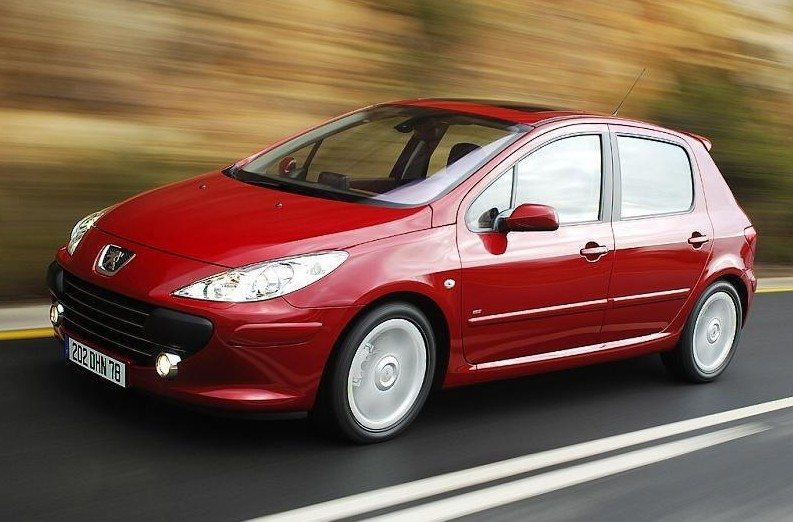
Peugeot 307
The Peugeot 307 is a compact family car produced by the French manufacturer Peugeot between 2001 and 2008. It replaced the Peugeot 306 and was known for its spacious interior, comfort-oriented ride, and modern design. Available in various body styles, the 307 became one of Peugeot’s best-selling models of the 2000s.
General Information
- Manufacturer: Peugeot (PSA Group)
- Model: Peugeot 307
- Production years: 2001 – 2008
- Assembly locations: France, Spain, Argentina, China
- Vehicle class: Compact car (C-segment)
- Body styles: 3-door hatchback, 5-door hatchback, station wagon (SW), sedan, convertible (CC)
Technical Specifications
Engines & Performance
- Engine types: Inline-4 petrol and diesel engines
- Petrol options: 1.4L, 1.6L, 1.8L, 2.0L (16-valve)
- Diesel options: 1.4 HDi, 1.6 HDi, 2.0 HDi (turbo diesel)
- Power output: 75 hp – 177 hp (for the 307 CC 2.0 or GTI versions)
- Transmission: 5-speed manual, 6-speed manual (later), or 4-speed automatic
- Drive type: Front-wheel drive (FWD)
- Top speed: 160 – 220 km/h depending on version
Chassis, Suspension & Brakes
- Front suspension: MacPherson strut
- Rear suspension: Torsion beam axle
- Brakes: Ventilated front discs and solid rear discs or drums (depending on model)
- Steering: Power-assisted rack and pinion
Dimensions & Weight
- Wheelbase: 2,610 mm
- Length: 4,210 – 4,420 mm (depending on body style)
- Width: 1,755 mm
- Height: 1,510 mm (hatchback), 1,530 mm (SW)
- Curb weight: 1,180 – 1,400 kg
- Fuel tank capacity: 60 liters
Interior & Features
- Seating capacity: 5 (7 for SW with optional third row)
- Dashboard design: Modern digital display and multifunction steering wheel
- Air conditioning: Manual or automatic climate control
- Infotainment: Radio/CD player, optional navigation
- Safety: Front, side, and curtain airbags; ABS; ESP (on higher trims)
Overview & Character
The Peugeot 307 offered a comfortable and practical driving experience, with emphasis on refinement rather than sportiness. Its higher seating position and large windows gave a sense of space and visibility. While not a performance car, it was appreciated for daily usability and smooth ride quality.
Pros & Cons
- + Spacious and comfortable interior
- + Good fuel efficiency (especially diesel versions)
- + Wide range of body styles and trims
- – Average reliability (especially in early models)
- – Steering and handling less sharp than rivals
- – Outdated infotainment and interior materials by modern standards
Notable Versions
- 307 SW – station wagon version with panoramic glass roof and optional 7 seats
- 307 CC – stylish convertible-coupé with retractable hardtop
- 307 GTi – sportier version with 2.0L 177 hp engine
